They need the whole incident: every message, every cross-connection, the story behind it. We prepare the case handover-ready - so that a police report becomes an investigation.
No professional has the time to go to the police himself, preserve evidence and keep track of proceedings.
Yet these tasks must not be left undone. The answer is not to do them yourself - it is to delegate them to experts.
With enough clients under contract, a serious incident is not a question of if but of when - purely statistically. You know your players; we determine when online hate turns into a genuine threat, real damage or a criminal offence. Together, the first indication becomes a file that authorities can work with.
What you hear as an agent - if anything is said at all: “I deleted it.” Players may often say nothing and delete, hoping the matter takes care of itself. It has still been seen and processed mentally. Or he comes to you: “Something strange happened here” - and shows you something you first have to make sense of yourself. We turn the incident into a usable case file - not only once it escalates.
Those who want to hurt a professional often go through the people around him: partners, parents and siblings have their own profiles - and become leverage. The same applies to coaches and staff in your portfolio: publicly exposed, usually without a security team of their own. No one has to become a security expert or untangle these connections themselves - we consider the entire environment, not just the individual account.
The more players you represent, the more certain it becomes, statistically, that one of them will be hit - threats, doxxing and extortion are then no longer isolated cases but a matter of probability. Turn that around: an agency that can offer its clients a dedicated security boutique alongside the lawyer has an argument in the race for new players that hardly any other agency has. Security then stops being a cost item and becomes a reason to sign with you.
Three patterns that fizzle out in proceedings without professional case preparation.
Anonymous accounts, an overstretched police force, no offender ID: most proceedings against online hate are dropped. Without investigative pressure the offender carries on unpunished - and your client lives with the threat. Whether the situation is escalating or calming down remains pure gut feeling without the right setup. Yet a decline in comments and threats is also a demonstrable success - if you measure it.
A viral pile-on or a targeted defamation campaign is not an abstract online phenomenon. The player reads along - before every training session, before every match, before going to sleep. Even if he keeps playing and you stand behind him: he is not a machine. Without structured case work he carries the burden alone.
The call comes on a Sunday evening: “I am getting those messages again - what can I do?” You know contract law and the market. OSINT, evidence preservation, identifying anonymous accounts are not your field - nor do they have to be. What you can show: you have actively brought external security expertise on board. That is your argument in the pitch for new players.
Online abuse in professional football is not abstract. FIFA and FIFPRO have empirically documented its impact on wellbeing, daily life and sporting performance - especially in women's professional football.
FIFPRO confirms internationally that online abuse directly affects the mental wellbeing, lifestyle and sporting performance of the players concerned - and with it their market value and career trajectory.
Sources: FIFA / FIFPRO · Social Media Protection Service Report - FIFA Women's World Cup 2023 (5.1 million posts analysed in 35 languages, 697 players and coaches supported). FIFPRO / NBPA / WNBPA · “Decoding Online Abuse” Report 2022 - international study on the impact of online abuse on wellbeing and performance.
And not just from the outside: our managing director passed the FIFA football agent exam himself.
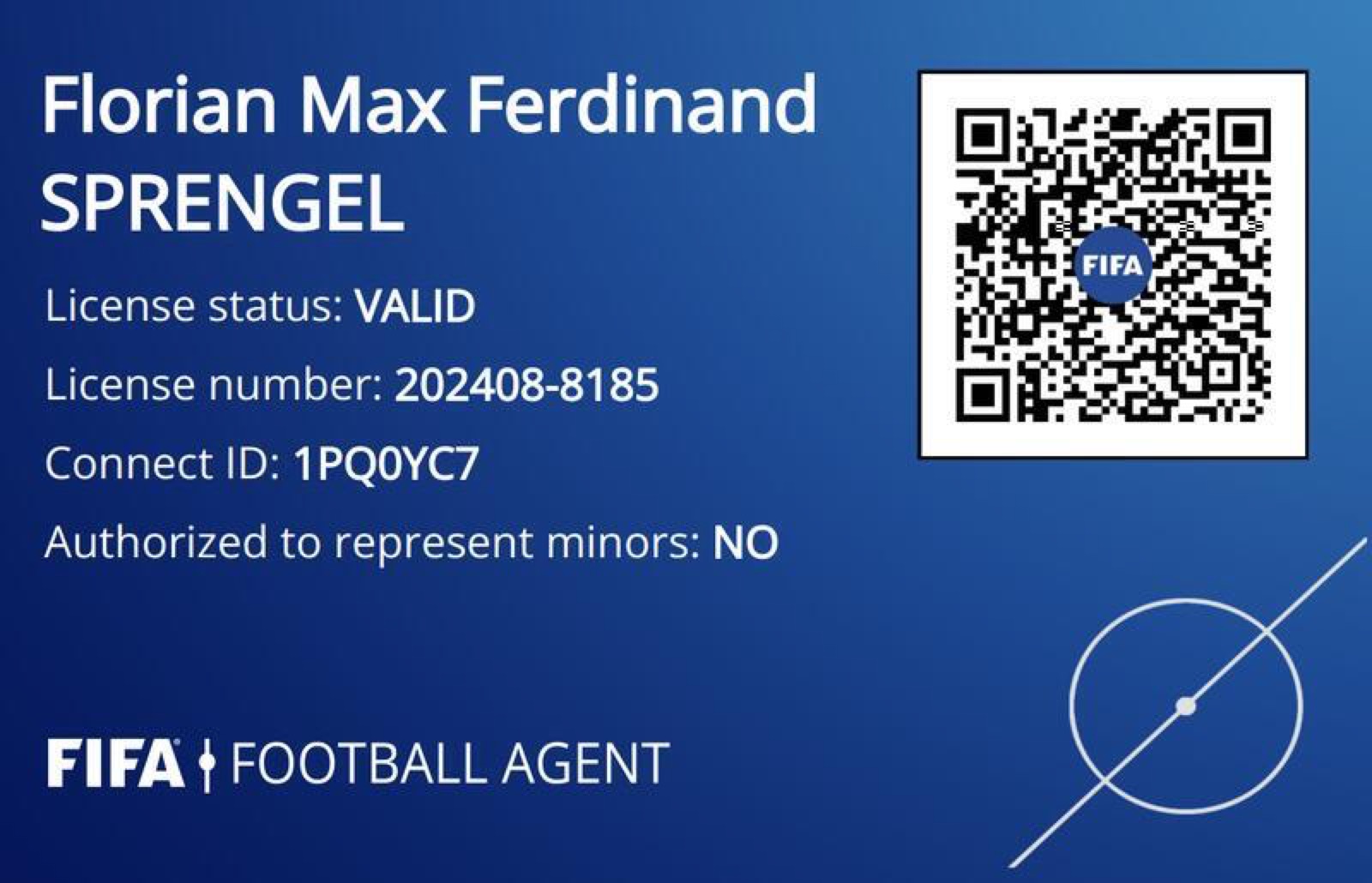
In 2025, our managing director passed the FIFA Football Agent Exam - licence number 202408-8185. This made him an officially licensed football agent under the reformed FIFA regulatory framework.
The exam - taken in person at the DFB in Frankfurt - is, as is well known, demanding. The worldwide pass rate was recently around 20 percent - anyone who holds the licence knows these numbers. This is not an end in itself: it demonstrates sound knowledge of the regulations and the transfer system your clients operate in.
And yet - quite openly: in your business, we cannot be better than you. No exam conjures up your experience in the market, your feel for players, contracts and negotiations. You remain the agent. We are the security discipline alongside.
The mirror image applies in reverse: player agents take their players' security into their own hands - without the expertise in this field that we have built over ten years with the police, an intelligence service and NASDAQ corporate security.
FIFA® and the term “FIFA Football Agent” are registered trademarks of the Fédération Internationale de Football Association. The exam mentioned was taken in 2025 under the FIFA Football Agent Regulations (2023). The licence is currently not actively maintained. We.Protect.Football. / 1530 Intelligence KG have no business or organisational affiliation with FIFA. “DFB” and “Deutscher Fußball-Bund” are registered trademarks of DFB e.V.; the mention is purely descriptive (exam venue) and does not imply any business affiliation.
A handful of providers in Germany offer hate speech detection. Detection and investigation from a single source - almost no one. Some send cease-and-desist letters. Others file reports with the police. We investigate connections - and deliver the right information to the right place at the right time.
We do not promise to deliver solid findings on every offender - no serious provider does. What we do promise: all available leads are brought together so that prosecutors and police can put the case on the right track straight away.
And in the proceedings it becomes visible that you did not treat your client's digital security as an afterthought - but took precautions before anyone struck.
Attackers operate professionally these days. Agents who respond the old way - wait, delete, dismiss - harm their client and themselves.
If something happens to a client - digitally or physically - and no documented protective measures are in place, things can become legally dangerous. The and the make prevention a duty. Without this demonstrable structure based on DIN/ISO standards, agents can, in a worst case, be personally liable with their private assets.
Public match schedules and social media profiles make professionals highly predictable targets. Anyone seeking an advantage may exploit every freely available piece of information (OSINT) - without scruple and up to the edge of what is legal. Public data can turn into movement patterns, and patterns into concrete points of attack. The danger starts digitally; it can end at the front door.
Targeted doxing, identity theft or complex extortion scenarios can place a heavy strain on a client's private life, mental state and career. Once the incident is there, containing it again takes a great deal of work. What matters is intervening early: defusing the situation before it escalates, instead of limiting damage afterwards.
Agents or clubs that cannot show documented protective measures face personal liability with their private assets if damage occurs.
A concrete case: the address ends up in the commercial register - because a holding structure was set up without a digital exposure check. The property is recorded in the land register under a real name. A sponsorship deal runs through the private address. A photo on social media reveals more than intended.
Each of these points is manageable on its own. Together they form a full picture: home address, financial situation, daily routine, personal environment. Anyone who can read that has options - for extortion, physical escalation or targeted reputational damage. A digital exposure check is not bureaucratic overhead. It is part of the threat architecture.
Every professional has legal counsel. Lawyers are experts in the legal processing and further use of findings once gained - that is their discipline. What comes before the legal step - operational investigation, offender identification, early evidence preservation - is not part of their toolbox. Implementing a protective shield - comparable to a small corporate security department - is often left to chance.
But security is not a matter of chance. It is a standard - built on clear norms (DIN/ISO) and implemented by practitioners.
…you as the agent may share responsibility for ensuring that professional security was brought in. Without a documented risk assessment, an accusation of breach of duty can arise - regardless of good intentions.
Managing director and agent liability can apply where neglect of protective measures can be demonstrated. D&O insurance may not pay out in cases of documented negligence - whether and to what extent is for your lawyer to clarify.
Documentation in line with DIN SPEC 14027, guided by ISO 18788. If damage occurs, the record shows: “We acted in line with the current state of the art.”
Initial call, facts of the case, evidence objective. Clarifying mandate, confidentiality, NDA.
Engagement letter, GDPR data processing agreement, defined scope.
We set up the monitoring and research systems for you - tailored to client and evidence objective.
Reviewing the first results with you. Prioritisation, approach, next steps.
We deliver the first reports. You check whether format and level of detail work for you.
A single report or completion of an ongoing monitoring system - encrypted via Tresorit or PGP mail.
Do not preserve material haphazardly on your own - it needs a method behind it. A single message says little; a hundred messages over two months document a pattern and show that someone is acting obsessively or with growing aggression. We.Protect.Football. documents this progression traceably, follows OSINT leads to the identity behind anonymous accounts - as far as open sources allow - and hands over a dossier that police and lawyers can act on.
Rarely. A screenshot proves neither authenticity nor authorship and is easy to challenge. Often it is not even clear where the offence took place and which police station has jurisdiction - at the player's place of residence, at the agency's offices where you are sitting in front of the computer, or at the (usually unknown) location of the offender? We preserve the incident methodically and traceably and frame it so that a complaint becomes a robust, prosecutable case.
Connections make the difference. If cross-connections reveal further concerning content that can be clearly attributed to the same person, the case moves onto an entirely different track. A single incident becomes an overall picture - and that opens up completely different lines of argument for police and lawyers.
True anonymity online is rare. Using OSINT - the structured analysis of publicly available sources - we link traces from profiles, writing patterns, metadata and cross-connections until an anonymous account can be attributed to a real person. Documented traceably, so the attribution holds up.
You describe the situation; we assess what is possible and which steps make sense. On request, we sign a non-disclosure agreement beforehand. Only then do you decide whether and how we act - sensitive case details do not belong in the first email anyway.
Strictly confidentially. Collection and reporting run on separate infrastructure, handover takes place via an end-to-end encrypted Swiss data room, with an NDA on request. Data minimisation applies - we collect only what carries the case.
Confidential. Open-ended. We clarify whether we are the right fit for your client. If not, we will tell you.